Why the same phone costs more here than there
Five reasons, and only one of them is still visible after the phone is in your hand — which is the one worth checking before you buy.
Price comparisons across borders circulate constantly, usually as evidence that somebody is being overcharged. The gap is real. The explanation is rarely the interesting one, and only part of it has any consequence for a buyer.
The five reasons
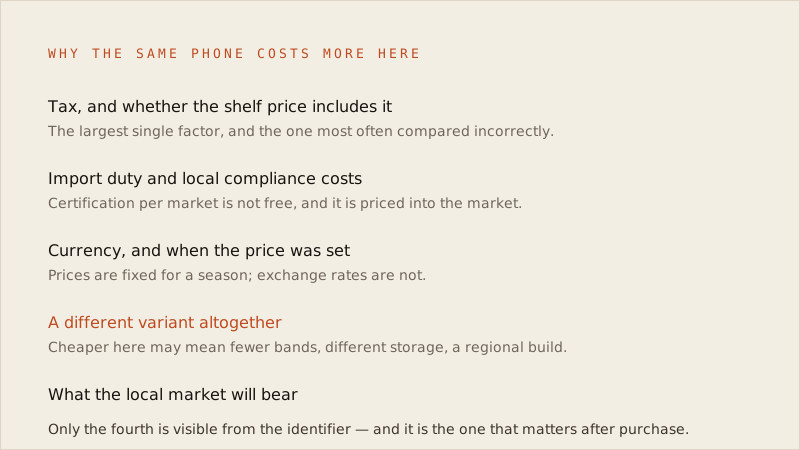
Tax is the largest single factor and the most frequently compared wrongly, because some markets quote prices including it and others do not. A large share of apparent price gaps disappears once both figures are put on the same basis.
Import duty and compliance costs come next. Certification is per market and is not free; that cost is priced into the market it was incurred for.
Currency matters in a specific way: prices are set for a season and exchange rates move continuously, so a gap can open without anybody deciding anything.
What the local market will bear is the honest last item — ordinary commercial pricing, varying with income levels, competition and how much operators subsidise.
The one that outlives the transaction
The fourth reason is different in kind: sometimes the cheaper phone is not the same phone.
A regional build may carry fewer bands, different storage, a different modem or a region-gated feature set. It is a genuine device from the same manufacturer under the same commercial name, and it is not equivalent.
What this means practically
For a buyer looking at a cross-border price gap, the useful question is not "why is it cheaper" but "is it the same variant". That is answerable from the identifier, before paying, and from essentially nothing else.
- Same variant, cheaper: the gap is tax, duty or currency, and the saving is real.
- Different variant, cheaper: the gap is at least partly the device, and the saving may be smaller than it looks.
- Different variant, and the missing bands are ones your networks use: not a saving at all.
The seller's version of the same question
For anyone buying stock across borders to resell, the identical logic applies with the sign reversed. Cheap stock from another market is only cheap if it is the variant your customers can use.
The operations that get burned here are the ones that price a purchase order from a model name and discover the variant on arrival. The ones that do not are running the identifiers before the container ships — which is the same check the individual buyer does, at a different scale.
Read next
Turn an IMEI into a device record.
Brand, model, code name, device type and radio bands, in one call. Tell us what you're building and we'll set you up with a key.