What a serial number is good for, and what it isn't
A serial number is the manufacturer's own bookkeeping. It answers warranty and repair questions precisely, and network questions not at all.
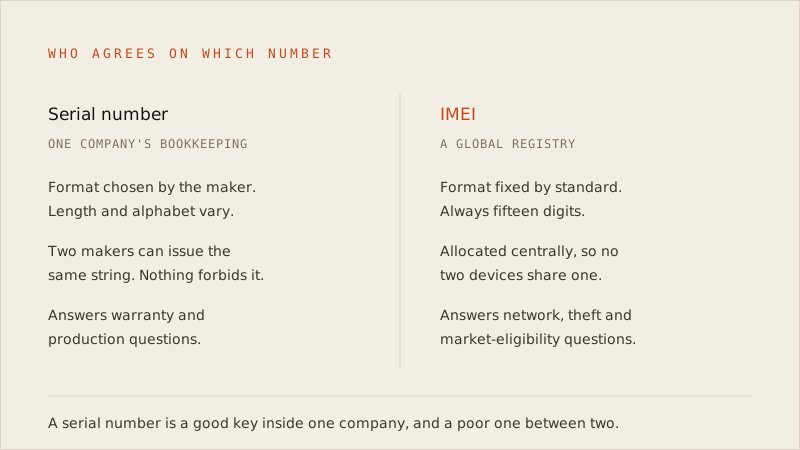
Every phone carries at least two numbers that look like identities. One of them is recognised by every operator on earth. The other is recognised by the company that built it, and by nobody else.
Both are useful. They are useful for different questions, and the cost of confusing them is paid later, usually by whoever inherits the database.
Two different kinds of number
The IMEI is allocated centrally. Its format is fixed by standard, its length is always fifteen digits, and the allocation process guarantees that no two devices share one. That guarantee is what lets an operator in one country act on a number issued to a manufacturer in another.
A serial number has none of that. The manufacturer picks the format, the length and the alphabet. It means whatever their production systems need it to mean — which factory, which line, which week, which batch. Two manufacturers can issue the identical string to two unrelated devices, and nothing anywhere forbids it.
This is not a flaw. A serial number is internal bookkeeping and is very good at being internal bookkeeping. It only becomes a problem when it is asked to do a job it was never designed for.
Which number answers which question
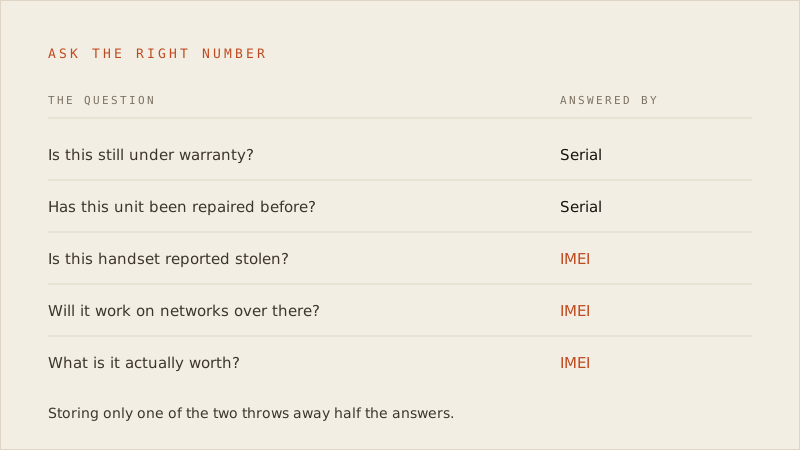
Warranty status, repair history and manufacturing provenance are the manufacturer's own records, keyed by their own number. Ask with an IMEI and you may get an answer, but you are going through a translation step that the serial number skips.
Network status, theft reports and market eligibility are the opposite. They live in systems shared between companies and across borders, and those systems key on the IMEI because it is the only identifier they all agree on.
Why storing only one is a mistake
Intake systems tend to capture whichever number is easiest to read off the device, and then discover the limitation months later.
- Storing only the serial: you can raise a warranty claim, but you cannot check whether the device was reported stolen, because the registries do not know what your serial number refers to.
- Storing only the IMEI: you can check the registries, but a manufacturer's support process will ask for a number you did not keep.
- Storing them without labelling which is which: the worst case, and more common than it sounds — a single "device_id" column holding both formats, discovered when someone tries to validate them all at once.
A note on reading them
The IMEI can be read from the handset itself by dialling *#06#, which is the only method that cannot be faked by swapping a sticker. A serial number usually has to be read from a label, from a settings screen, or from the box — and the box is the least trustworthy of the three, because boxes and devices get separated.
Where the two disagree — a serial on the label that does not match the one in the settings screen, or an IMEI on the sticker that differs from the dialled one — the device has been opened, rebuilt, or is not what it is being presented as. That disagreement is itself the useful signal, and it is only available to systems that bothered to record both.
Read next
Turn an IMEI into a device record.
Brand, model, code name, device type and radio bands, in one call. Tell us what you're building and we'll set you up with a key.