Why a phone has four names, and which one to key on
A project code name, a model number, a commercial name and a carrier name. Only one of them is precise enough to order a part against.
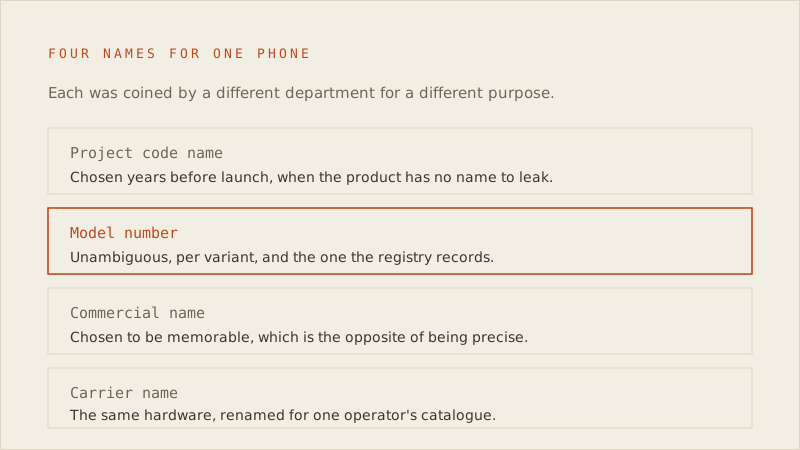
By the time a phone reaches a shelf it has accumulated at least four names, each invented by a different part of the company for a different purpose. None of them is wrong. Only one of them is useful as a key.
Where each name comes from
The project code name is chosen years before launch, when the product needs to be discussed internally and across suppliers without leaking anything. It is deliberately arbitrary — a bird, a river, a city — because arbitrary names carry no information if they escape.
The model number is engineering's answer. It is precise, it distinguishes variants, and it is what appears on certification paperwork and in the registry. It is also the least memorable of the four, which is why marketing does not use it.
The commercial name is chosen to be memorable, and memorability is achieved by covering over detail. "Galaxy S24" is easier to say than four model numbers, which is exactly the problem when you need one of the four.
The carrier name is the same hardware renamed for one operator's catalogue, a practice that has faded in some markets and persists in others. It exists for merchandising reasons and creates a fifth string referring to the same device.
The cost of keying on the wrong one
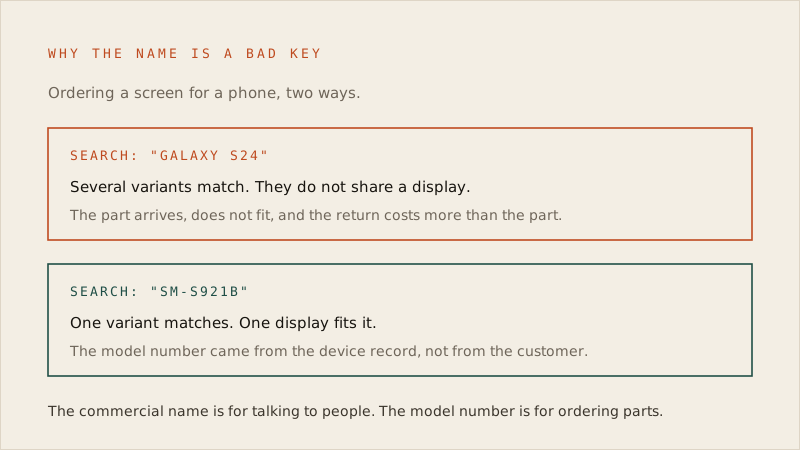
Parts is where this bites hardest and soonest. Displays, boards and cameras diverge between variants of one commercial model, so a search on the marketing name returns several candidates that are not interchangeable. The part arrives, does not fit, and the return costs more than the part did.
Pricing is the quieter version. A single price attached to a commercial name averages across variants whose resale values differ, so every transaction is slightly wrong in one direction or the other and the errors do not cancel out — they follow whichever variant is more common in your stock.
Catalogue integrity is the third. Systems keyed on the commercial name merge devices that should be separate; systems keyed on the code name split devices customers think of as one product. Both are wrong, in opposite directions, and a system usually manages to do both at once in different places.
The shape that survives
The reason this matters practically is that the two levels are populated from different sources. The commercial name comes from marketing material and is what you show in a listing. The model number comes from resolving the identifier, and is what you order parts and set prices against.
Operations that collapse the two into a single "model" field are not saving a column. They are deciding, once and permanently, to be imprecise about the thing their margins depend on.
Read next
Turn an IMEI into a device record.
Brand, model, code name, device type and radio bands, in one call. Tell us what you're building and we'll set you up with a key.