Where the eSIM fits when there's no tray to look in
An eSIM replaces the card, not the device's identity. What an EID actually is, how it relates to the IMEI, and why removing the tray didn't remove the lookup problem.
Last updated 2026-06-09
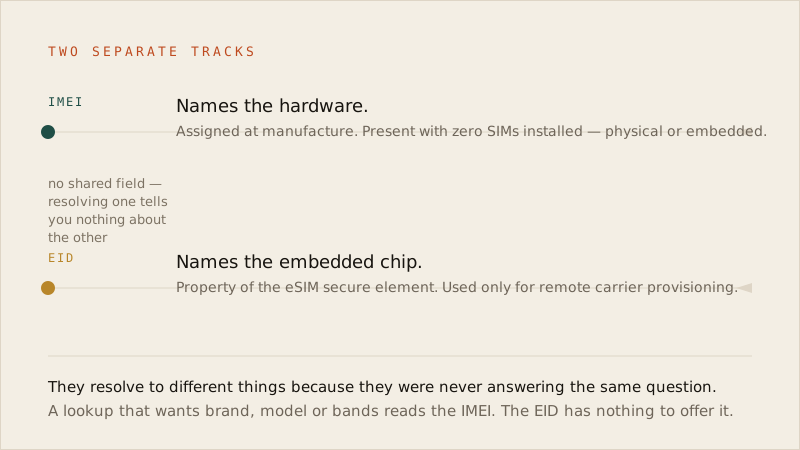
More devices ship with no tray at all every year, and the assumption that follows is a natural one: no card, nothing to look up. It is also wrong. The identifier this register cares about was never printed on the card in the first place.
Two different questions
An IMEI answers "what is this piece of hardware". It is assigned to the modem at manufacture and present whether the device has ever held a SIM of any kind, physical or embedded. An EID answers a different question entirely: "which embedded chip is soldered into this unit, and which carrier profiles can be loaded onto it". It is a property of the eSIM's secure element, not of the phone as a whole.
| IMEI | EID | |
|---|---|---|
| Names | The radio hardware | The embedded SIM chip |
| Format | 15 decimal digits | 32 decimal digits |
| Assigned by | Manufacturer, at build | Chip maker, at manufacture |
| Resolves to | Brand, model, code name, type | Nothing outside carrier provisioning |
Why a device can carry more than one IMEI, tray or no tray
Dual-line phones commonly report two IMEIs, and people who have only ever seen this on dual-SIM-tray devices sometimes assume the second number is a consequence of the second physical card. It is not. The count tracks active radio contexts — how many independent connections the modem can maintain — not the technology carrying the profile. A dual-eSIM, tray-less phone with two active lines reports two IMEIs for the same reason a dual-tray phone does.
Where an EID actually shows up
Almost entirely in provisioning. Activating an eSIM by QR code or carrier app is remote SIM provisioning targeting a specific chip, and the EID is how the network tells one customer's embedded SIM apart from every other one in the field. Outside that handshake, an EID has no reason to reach an intake system, a resale listing, or a support ticket.
What actually changed for a lookup process
Nothing about IMEI structure or TAC allocation moved because of eSIM. The shift is orthogonal to device identity — it changed how a profile gets onto a phone, not what the phone is. Where it does bite is procedural: intake scripts and staff habits built around "read the fifteen digits off the label under the SIM tray" quietly stop working the moment the tray is gone, because there was never a label to read.
The fifteen digits still live in the same places they always did: the dialler code, the settings screen, the retail box, and the carrier's own account records. None of those depend on a physical card being present.
Practical guidance
- Stop treating a tray-less device as a harder intake case. It is not — the retrieval method just moves from the card to the dialler code or settings screen.
- If a workflow still instructs anyone to "check the SIM slot" for the IMEI, that instruction predates a meaningful share of current hardware and is due a rewrite.
- Never substitute an EID for an IMEI in a record. They are both fifteen-or-so digits of device-adjacent number, which is exactly similar enough to get merged into the wrong field by someone in a hurry.
Read next
Turn an IMEI into a device record.
Brand, model, code name, device type and radio bands, in one call. Tell us what you're building and we'll set you up with a key.