The blacklist is national. The device is not.
A phone blocked in one country can be working again two borders later. Why blacklist coverage is a patchwork, and what that means for anyone buying or exporting used devices.
Last updated 2026-08-03
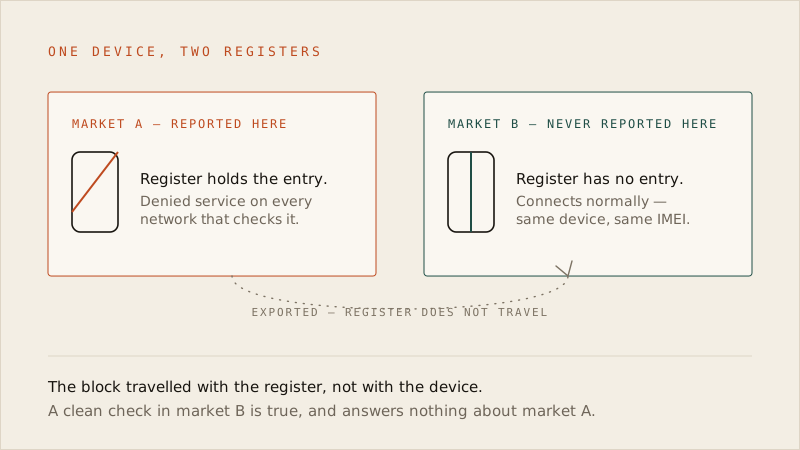
A handset blocked on every network in the country it was stolen from can be connected, working, and for sale two borders away within the week. This is not a flaw anyone is quietly exploiting — it is a direct, structural consequence of how blocking is organised, and it matters most to exactly the businesses that move used hardware across borders for a living.
The short version of the mechanism
Elsewhere on this site we cover how an Equipment Identity Register works and what a block does and does not do. The part worth restating here in one line: a network checks a device against its own register, operators share entries upward on a largely voluntary basis, and some countries additionally run their own government-mandated register on top of that. None of it is global by default.
Why the map has gaps
Coverage sorts roughly into three situations. Some markets mandate registration — a device has to be registered against the network, sometimes tied to the owner's national ID, before it receives service at all, and a blocked or unregistered IMEI is refused outright. Others rely purely on the shared, voluntary exchange between operators, which reaches a meaningful share of global traffic but nothing close to all of it. And in some markets, enforcement in practice is thin regardless of what is written down, because there is little to gain locally from stopping a device that was reported stolen somewhere else.
What this means specifically for cross-border trade
A wholesaler clearing a pallet of used devices against the destination market's register has confirmed exactly one thing: that those devices are not currently blocked there. It says nothing about the origin market's register, which may hold an entry that the destination network has never seen and has no reason to check.
This creates a standing, entirely predictable economic gradient: devices reported stolen in markets with strong, well-enforced registers are worth more once moved to a market with weaker coverage, purely because the block does not follow them there. It is the same logic that drives any arbitrage — the asset is worth different amounts depending on which jurisdiction is asked about it — applied to a stolen handset instead of a commodity.
Reading a clean result correctly, twice
Two separate cautions apply here, and they point in different directions in time. The first is backward-looking: a device can check clean today because the report simply has not been filed yet — the window between a theft and its entry appearing in any register is measured in hours or days. The second is forward-looking, and gets less attention: a device that checks clean today, gets exported, and is resold tomorrow can still have a report filed against it the day after — in a register the buyer never queried, or that did not yet hold the entry at the moment of sale.
- Treat a single-market check as clearance for that market only, never as a global statement about the device.
- For anything crossing a border as part of the transaction, check against the destination market's register at minimum, and the origin market's where it can be identified and queried.
- Keep dated records of when a device was checked and against what. If a report lands after resale, the timestamp is what shows the check was made in good faith rather than skipped.
- Treat a device's declared country of origin as an input worth recording, not a detail to discard once the sale is logged — it is the field that tells you which register was actually relevant.
None of this makes cross-border resale of used devices suspect by default — it is a large, legitimate industry. It does mean that "clean" is a claim about a register, not about a device, and that the claim has a jurisdiction attached whether or not anyone states it out loud.
Read next
Turn an IMEI into a device record.
Brand, model, code name, device type and radio bands, in one call. Tell us what you're building and we'll set you up with a key.