What actually happens after you report a phone stolen
The chain from a police report to a blocked handset runs through several organisations. Where it works, where it stalls, and what to do in the first hour.
Reporting a stolen phone feels like one action. It is at least three, handled by different organisations that do not share a queue, and the outcome depends on doing all of them rather than the most obvious one.
The first hour
Order matters here, because the steps protect different things and some of them stop being possible once the device is switched off.
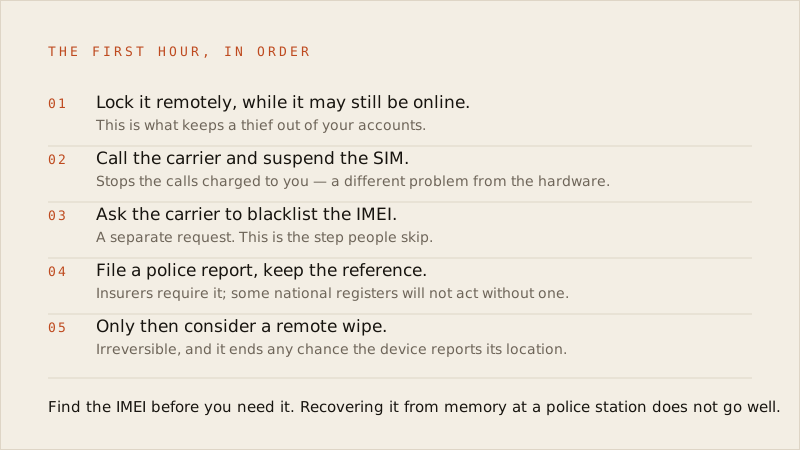
- Lock the device remotely, while it may still be online. Both major mobile platforms offer this, and lost-mode locking is what keeps a thief out of your accounts.
- Call your carrier and suspend the SIM. This stops the calls and messages charged to you — which is a different problem from the hardware, and often the more expensive one.
- Ask the carrier to blacklist the IMEI. This is a separate request from suspending the line, and it is the step people most often skip.
- File a police report and keep the reference number. Insurers require it, and in several countries the national register will only accept an entry that references one.
- Only then consider remote wipe. It is irreversible and it ends any remaining chance of the device reporting its location.
Where the report travels
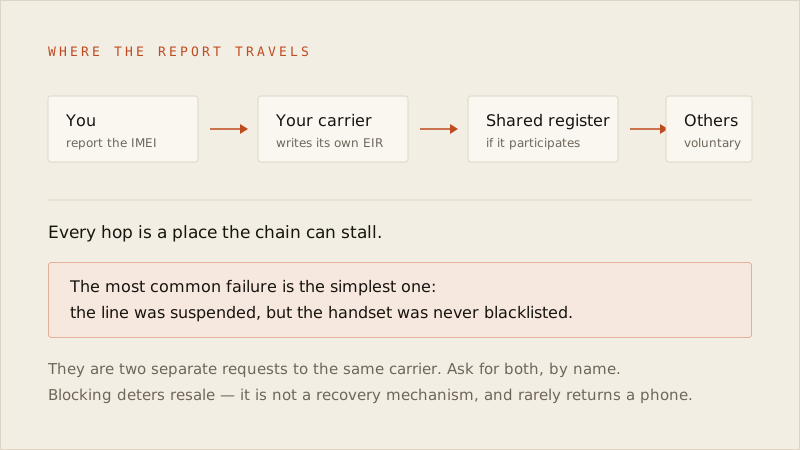
Once filed, the identifier moves along a chain. Your carrier writes it into its own equipment register, which blocks the handset on that network. If the operator participates in shared blocking, the entry is passed to the central register the GSMA maintains, and from there to other participating operators. Where a national register exists, the police report and the carrier entry feed into it under whatever rules the local regulator has set.
Each hop is a place the chain can stall. The most common failure is the simplest: the line was suspended but the handset was never blacklisted, because the customer asked for one and assumed it included the other.
Why recovery rates disappoint
Blocking is a deterrent against resale, not a recovery mechanism. Three structural reasons a blocked phone is rarely a returned phone:
- Blocking is territorial. Devices move to markets that do not honour the block, and that movement is organised, not accidental.
- A blocked handset still has value as parts. Screens and boards do not carry the identifier that was blocked.
- Police forces triage. An individual handset theft with no injury and no suspect is, realistically, a report number and an insurance document.
None of that makes reporting pointless. Blacklisting measurably reduces what a stolen device is worth, and the aggregate reports are what regulators use when they decide whether shared blocking should be mandatory rather than optional.
If you buy and sell used devices
The same chain, read from the other side, tells you where your exposure is. You will be offered devices during the reporting window, before any register has heard about them — that is not a hypothetical, it is the normal case for recently stolen stock.
- Record the IMEI of everything you take in, with the date and the seller. If a device is later reported, having the record is the difference between cooperating and being investigated.
- Re-check stock that sits in inventory. A device that was clean on intake may not be clean a week later, and the recheck costs one lookup.
- Check the activation lock as well as the block. It is the constraint that actually stops you reselling.
- Keep identity records for sellers, to whatever standard your jurisdiction requires — in several countries this is a legal obligation for second-hand dealers rather than a best practice.
The recheck point is the one that gets missed. An intake check answers a question about the moment of intake; stock that sits for weeks needs the question asked again.
Read next
Turn an IMEI into a device record.
Brand, model, code name, device type and radio bands, in one call. Tell us what you're building and we'll set you up with a key.