One phone name, many actual devices
The name on the box is marketing. Underneath it sit regional variants, carrier builds and separate code names — and they are not interchangeable.
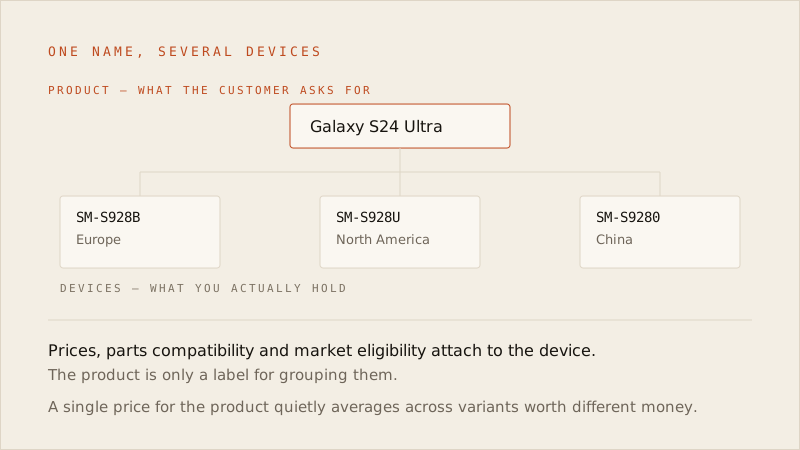
A phone has at least two names. The one on the box, chosen to be memorable, and the one the manufacturer uses internally, chosen to be unambiguous. The gap between them is where a great deal of operational confusion lives.
"iPhone 11" is a product. A2221 is a device. They are not the same kind of noun, and a system that stores only the first has thrown away information it will later want.
Why one product becomes several devices
- Radio bands. Spectrum allocation differs by region, so the same product is built with different radio configurations for different markets — and a handset built for one region may be crippled or unusable in another.
- Carrier builds. In markets where operators commission their own versions, the same phone ships with different firmware, different bundled software, and sometimes different hardware.
- Regulatory certification. Approval is granted per market, and the variant submitted for approval is the variant that may be sold there.
- Manufacturing arrangements. Assembly at more than one site, or under more than one legal entity, can produce separately registered devices.
Each of those can mean a separate code name and, frequently, a separate Type Allocation Code. The commercial name papers over all of it.
Where this bites
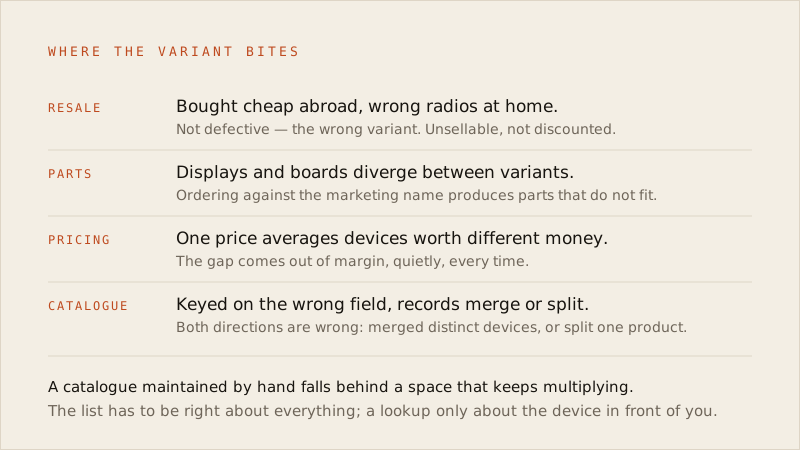
The consequences are concrete and expensive:
- Cross-border resale. A device bought cheaply in one market and shipped to another can arrive with a radio profile that does not match the destination's networks. It is not defective; it is the wrong variant.
- Repair parts. Displays, boards and cameras diverge between variants of the same commercial model. Ordering against the marketing name produces parts that do not fit.
- Pricing tables keyed on the wrong field. A single price for "Galaxy S24 Ultra" quietly averages across variants with different resale values.
- Duplicate catalogue entries. Systems that key on the commercial name merge devices that should be distinct — and systems that key on the code name split devices users think of as one product. Both are wrong in different directions.
Modelling it properly
The shape that survives contact with reality is two levels: a product, which is what the customer recognises, and a device, which is what you actually hold. One product has many devices. Prices, parts compatibility and market eligibility attach to the device; the product is a label for grouping.
Resolving an IMEI gives you the device level directly — the code name and the radio profile alongside the commercial name — which is why intake systems built on lookups rather than on dropdowns tend not to acquire this class of bug in the first place.
A note on model proliferation
The number of distinct devices in circulation grows faster than the number of phones people think exist, because every additional market, carrier and configuration multiplies rather than adds. Any catalogue maintained by hand falls behind this; the question is only how quickly.
That is the practical case for resolving identity from the hardware rather than maintaining a list: the list has to be right about a space that keeps growing, and the lookup only has to be right about the device in front of you.
Read next
Turn an IMEI into a device record.
Brand, model, code name, device type and radio bands, in one call. Tell us what you're building and we'll set you up with a key.