The MEID, and why it outlived the networks it was built for
Fourteen hexadecimal digits from the CDMA era. The networks are switched off, the numbers are still in your database — and intake systems still have to recognise them.
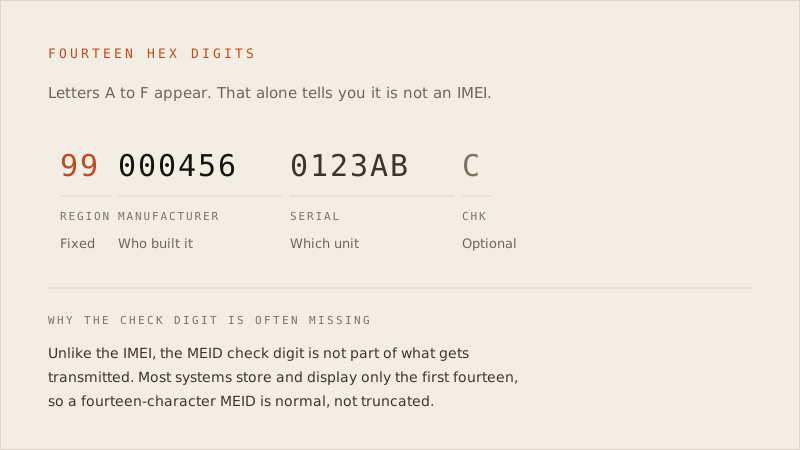
The Mobile Equipment Identifier was the CDMA world's answer to the IMEI: a unique number for a piece of hardware, allocated centrally, used by the network to tell one handset from another. Same job, different family of networks, different notation.
Those networks have largely been switched off. The identifiers have not gone anywhere, and that is the practical problem.
How to recognise one
An MEID is fourteen hexadecimal digits. Hexadecimal is the giveaway: if you see letters A through F in what someone has handed you as an "IMEI", it is not one.
| IMEI | MEID | |
|---|---|---|
| Length | 15 digits | 14 characters |
| Alphabet | 0–9 only | 0–9 and A–F |
| Check digit | Part of the number | Usually omitted |
| Origin | GSM family | CDMA family |
The check digit deserves a note, because its absence looks like data loss and is not. Unlike the IMEI's Luhn digit, the MEID's check character is not part of what gets transmitted, so most systems store and display only the first fourteen. A fourteen-character MEID is complete, not truncated.
The part that trips people up
Many devices from the transitional years carry both numbers. A handset built for a CDMA network but capable of GSM roaming has an MEID and an IMEI, and they are related: the IMEI is frequently derived from the MEID rather than allocated separately.
This means the same physical phone can be described by two different identifiers, both correct, neither interchangeable in a lookup. Systems that assume one device means one number will produce duplicate records for a single handset, or will fail to match an incoming number against the one they stored.
Where you still meet it
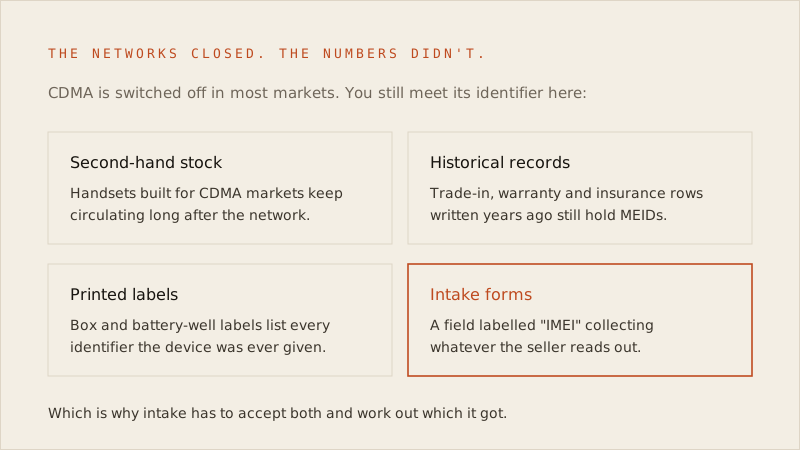
Second-hand handsets built for CDMA markets keep circulating for years after the network that justified them. Trade-in, warranty and insurance rows written a decade ago still hold MEIDs, and any migration of that data carries them forward. Box and battery-well labels list every identifier a device was ever given, so whoever reads one out may read out either.
And then there is the intake form: a single field labelled "IMEI", collecting whatever the seller has in front of them.
What to do about it
The robust approach is to stop asking people to classify the number and classify it yourself. The two formats are trivially distinguishable — length, and whether any letters appear — so an intake field can accept either and work out which it received.
- Accept the input without insisting on a format. Strip spaces and dashes before looking at it.
- Decide what it is: fifteen digits with no letters is an IMEI; fourteen characters with hex letters is an MEID.
- Validate accordingly. The Luhn test applies to the IMEI and is meaningless against an MEID.
- Store what you were given alongside what you resolved, so a mismatch later can be traced to the input rather than argued about.
None of this is difficult. It is simply work that gets skipped when a system is designed around the assumption that every device has exactly one identifier and it is always fifteen digits long — an assumption that was never quite true, and is least true of the second-hand stock most likely to arrive at your counter.
Read next
Turn an IMEI into a device record.
Brand, model, code name, device type and radio bands, in one call. Tell us what you're building and we'll set you up with a key.