When a genuine replacement part still trips a warning
Some manufacturers tie internal components to one specific handset in software. What that has to do with device identity, why regulators are pushing back, and what it means for repair and refurbishment.
Last updated 2026-07-22
A shop pulls a screen from a donor unit of the exact same model, fits it, and the replacement works — except for a persistent warning, a disabled feature, or a battery-health readout that now says "Unknown Part". The part is not counterfeit. It was simply never introduced to this particular handset.
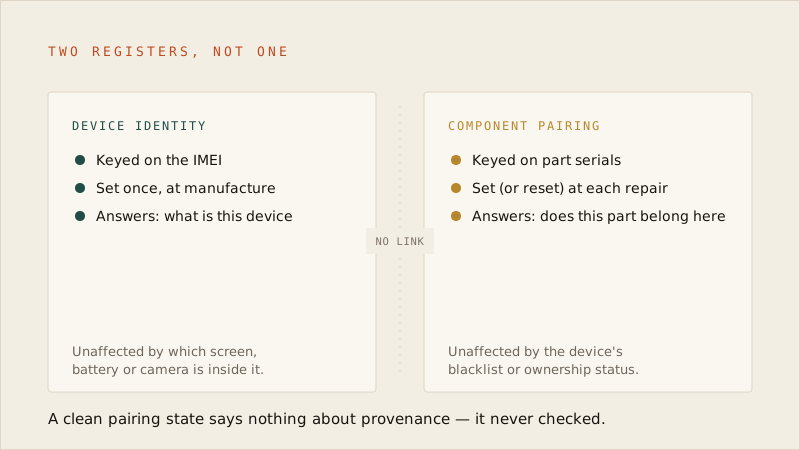
Two registers, not one
It is worth separating this cleanly from everything else on this site. The IMEI identifies the device as a whole — the modem, at the level a network cares about. A growing number of manufacturers separately serialise individual components — the screen, the battery, sometimes the camera module — and record in software which serial is expected to be paired with which handset. These are two different registers, built for two different purposes, and a device's IMEI standing has no bearing on whether its parts are paired.
Why manufacturers do it
The stated reasons cluster around three arguments: quality control, since an unpaired part skips a calibration step the manufacturer would otherwise run; counterfeit deterrence, making it harder to pass off a substandard component as original; and a slower, less advertised one — reducing the payoff of breaking a stolen phone for parts, since a harvested screen or battery loses some of its value the moment it can no longer be silently paired into a replacement.
The regulatory pushback
Right-to-repair rules moving through the EU and several other jurisdictions increasingly target exactly this behaviour — not banning serialised parts outright, but requiring that independent repairers get a practical path to pairing, rather than having the feature reserved for an authorised network. The direction of travel is consistent even where the specifics differ: pairing itself is being treated as acceptable, silent lock-out of independent repair is not. Some manufacturers have already opened self-service pairing through a repair portal keyed to the device's own serial, ahead of being required to.
What it means on the bench
For a repair or refurbishment operation, the practical shift is procedural rather than technical. A warning after a swap is no longer sufficient evidence that the part is faulty — it is equally consistent with a perfectly good part that simply hasn't been introduced to the new host. Troubleshooting needs to ask which case it is before reaching for a second replacement part.
- Budget pairing as a step in its own right, not an afterthought — sourcing a donor part and fitting it are no longer the whole job on affected models.
- Keep the two failure modes apart on the intake sheet: "part reports unpaired" and "part is defective" send a technician down different paths, and conflating them wastes a second part.
- When buying broken devices specifically for parts, resolve the exact model and variant from the IMEI first — pairing tooling and eligibility are frequently specific to a variant, not just a model family, the same distinction that matters for buyback pricing.
None of this is likely to be resolved by a single regulation or a single manufacturer policy change. It is a standing point of friction between two goals — component security and independent repairability — that both sides have reasons to keep pursuing. Building it into the process now costs less than treating each occurrence as a surprise.
Read next
Turn an IMEI into a device record.
Brand, model, code name, device type and radio bands, in one call. Tell us what you're building and we'll set you up with a key.