How the world's phones get counted, and why the numbers disagree
Shipments, connections, subscribers, installed base: four different quantities routinely quoted as one. What each actually measures.
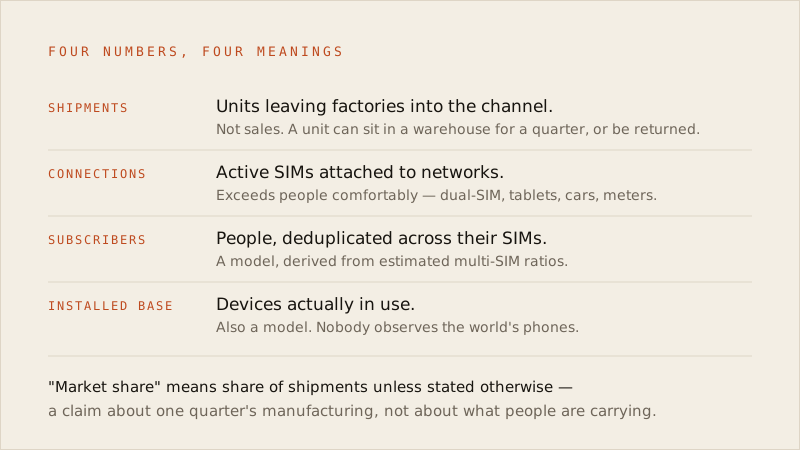
Ask how many mobile phones exist and you will get several confident answers that differ by billions. None of them is necessarily wrong. They are measuring different things, and the difference is worth understanding before you put any of them in a business case.
Four quantities, four meanings
| Measure | What it counts | Who produces it |
|---|---|---|
| Shipments | Units leaving manufacturers into the sales channel, per quarter | Market research firms, from supply-chain data |
| Connections | Active SIMs attached to networks | Operators, aggregated by industry bodies |
| Unique subscribers | People, deduplicated across their SIMs | Modelled from connection data |
| Installed base | Devices actually in use | Estimated from shipments and retirement curves |
The gaps between them are large and systematic, not noise:
- Connections exceed people, comfortably. Dual-SIM handsets, separate work lines, tablets, cars and metering equipment all hold SIMs, and each is a connection.
- Shipments are not sales. A unit shipped into the channel may sit in a warehouse for a quarter, or be returned. Shipment figures lead consumer demand rather than describing it.
- Installed base is a model, not a count. Nobody observes the world's phones. The figure is shipments accumulated over years, minus an assumption about how fast devices are retired — and that assumption is doing enormous work.
- Unique subscribers is also a model, derived by estimating multi-SIM ratios per market.
Orders of magnitude
For a rough sense of scale in the mid-2020s: mobile connections worldwide run to several billions more than there are people; unique subscribers are somewhat over half the world's population; annual smartphone shipments are on the order of a billion units; and the smartphone installed base is several billion. The precise values move every quarter and the sources revise them retroactively.
The useful takeaway is the ratio, not the value. Roughly speaking, the world buys around a billion smartphones a year against an installed base several times that — which implies an average replacement cycle measured in years, not months, and that single ratio drives most of the second-hand market's economics.
What a TAC register can and cannot contribute
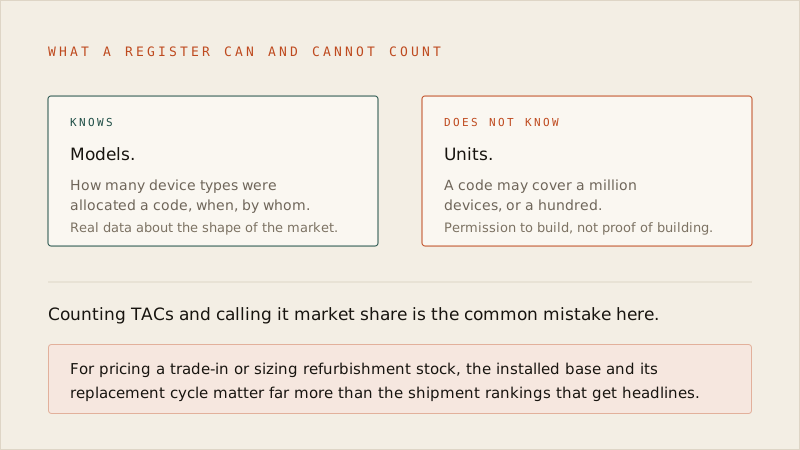
It is tempting to treat a device-identity register as a census. It is not, and the reason is instructive.
A register knows about **models** — how many distinct device types have been allocated a code, when, and by whom. That is genuinely useful data about the shape of the market: how model proliferation is trending, how many variants a manufacturer ships, how quickly new hardware appears.
What it does not know is how many units of each model exist. A TAC allocation is permission to build, not evidence of having built. A code may cover a million units or a hundred. Counting TACs and calling it market share is one of the more common mistakes made with this data.
Reading vendor statistics without being misled
- Check the unit. "Market share" means share of shipments unless stated otherwise — which is a claim about a quarter's manufacturing, not about what people are carrying.
- Check the geography. Global figures hide enormous regional divergence; a device mix that is representative worldwide is representative almost nowhere in particular.
- Check the revision history. Serious sources restate past quarters as better data arrives. A figure that has never been revised has probably never been checked.
- Do not mix sources within one comparison. Different firms use different definitions of a smartphone, of a quarter, and of a region.
For most operational purposes — pricing a trade-in, planning refurbishment stock, sizing a market — the installed base and its replacement cycle matter far more than the shipment rankings that get the headlines.
Read next
Turn an IMEI into a device record.
Brand, model, code name, device type and radio bands, in one call. Tell us what you're building and we'll set you up with a key.